Nixon's Nuclear Specter: The Secret Alert of 1969, Madman Diplomacy, and the Vietnam War by Jeffrey P. Kimball & William Burr
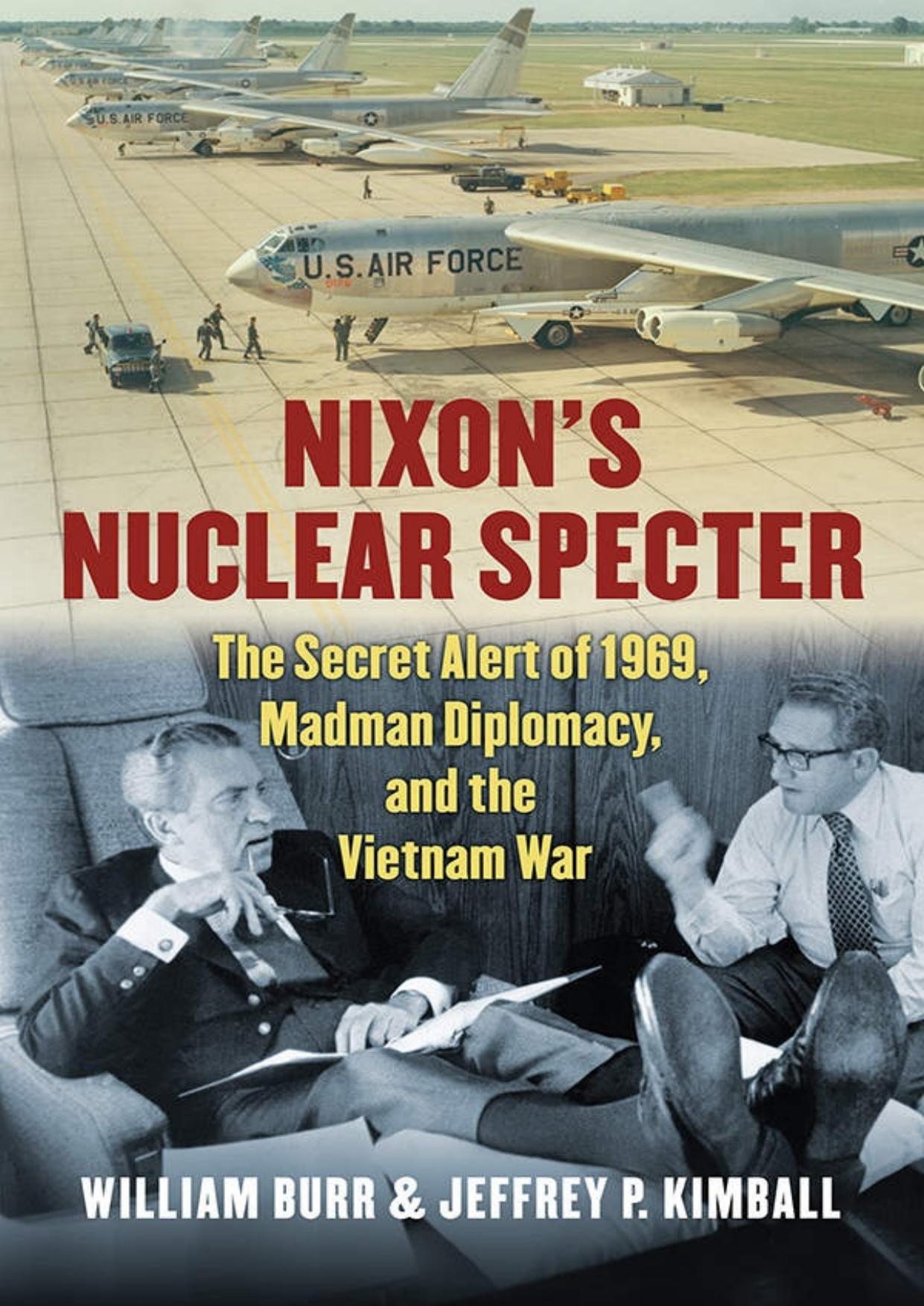
Author:Jeffrey P. Kimball & William Burr [Kimball, Jeffrey P.]
Language: eng
Format: epub, pdf
Publisher: University Press of Kansas
Published: 2015-07-04T23:00:00+00:00
Aborting the “Tough Option”
Nixon approved the DUCK HOOK goal of signaling Hanoi’s leaders that he would “go to almost any length to end the war quickly,” since it conformed to his own oft-repeated attraction to and faith in the Madman Theory. But it was one thing to issue threats and prepare detailed attack plans, and it was another to follow through. By the first week of October, if not before, Nixon’s resolve in favor of the November Option operation began to fade in the face of several considerations.
One had to do with doubts about the efficacy of the November Option concept in either version, whether DUCK HOOK or PRUNING KNIFE. Several of the planners in the September Group had expressed reservations about the prospects for achieving its military goals. They cautioned, for example, that “the probability of success is heavily dependent on the weather.… Thus, for … Phase I we could expect a high probability of partial success—i.e., the establishment of the sea quarantine—but questionable prospects for accomplishing the desired effect on all targets.” In addition, US military actions in both phases of the operation ran the risk of incurring US aircraft losses, including some of their crews, of up to 5 percent, “as well as inflicting considerable NVN civilian casualties.” As Tony Lake and Roger Morris had cautioned back on 17 and 29 September, the proposed attacks on Red River dikes in particular were likely to cause considerable collateral civilian casualties and provoke strong protests at home and abroad. Even though Kissinger had criticized the JCS PRUNING KNIFE plan because some of its recommended military actions increased the chance of producing civilian casualties, the plan’s only solution to the problem of public and intragovernmental disapproval was to recommend a policy that Nixon did not believe was sustainable: “To strike and maintain a political posture clearly immune to all likely pressures against continuing the action so long as Hanoi refuses to compromise.”43
Reactions and counteractions by North Vietnam and its allies, moreover, could reduce the operation’s impact and undermine its purpose. Hanoi’s leaders might misconstrue the purpose of the operation, uncertain whether it was an “act of desperation or the beginning of a long and persistent campaign.” In either case, they could take retaliatory steps, such as threatening to expand the war in Cambodia and Laos, breaking off Paris talks, and calling for foreign “volunteers” to fight in Indochina. Moscow’s counteractions might assume the form of taking steps to undercut or mitigate the US sea quarantine and also replace North Vietnamese aircraft destroyed in the US attacks. The Soviets might supply personnel for certain North Vietnamese operations, such as air defense, and they might respond diplomatically or military in areas outside of Indochina. Another risk was that the United States would have to “be prepared to spill Soviet blood and to inflict damage to Soviet ships, if this proves necessary.” In any event, there was only a fifty-fifty chance that Moscow would pressure Hanoi to change its negotiating position in response to DUCK HOOK.
Download
Nixon's Nuclear Specter: The Secret Alert of 1969, Madman Diplomacy, and the Vietnam War by Jeffrey P. Kimball & William Burr.pdf
This site does not store any files on its server. We only index and link to content provided by other sites. Please contact the content providers to delete copyright contents if any and email us, we'll remove relevant links or contents immediately.
| Africa | Americas |
| Arctic & Antarctica | Asia |
| Australia & Oceania | Europe |
| Middle East | Russia |
| United States | World |
| Ancient Civilizations | Military |
| Historical Study & Educational Resources |
The Radium Girls by Kate Moore(12112)
100 Deadly Skills by Clint Emerson(4984)
Rise and Kill First by Ronen Bergman(4857)
The Templars by Dan Jones(4751)
The Doomsday Machine by Daniel Ellsberg(4576)
The Rape of Nanking by Iris Chang(4276)
Killing England by Bill O'Reilly(4065)
Stalin by Stephen Kotkin(4024)
Hitler in Los Angeles by Steven J. Ross(3993)
12 Strong by Doug Stanton(3590)
Hitler's Monsters by Eric Kurlander(3412)
The Code Book by Simon Singh(3269)
Blood and Sand by Alex Von Tunzelmann(3256)
Darkest Hour by Anthony McCarten(3184)
The Art of War Visualized by Jessica Hagy(3058)
Hitler's Flying Saucers: A Guide to German Flying Discs of the Second World War by Stevens Henry(2785)
Babylon's Ark by Lawrence Anthony(2744)
Tobruk by Peter Fitzsimons(2575)
The Second World Wars by Victor Davis Hanson(2559)
